Sodium vs. Potassium Permanganate
Sodium permanganate and potassium permanganate deliver the same oxidant, the permanganate ion (MnO₄⁻), and do the same chemistry in the ground. The choice between them is about logistics: potassium permanganate is the dry, lower-cost form that mixes to about 5%; sodium permanganate is the 40% liquid that needs no dissolving and far less water. Here is the comparison, the conversion arithmetic, and when each one wins.
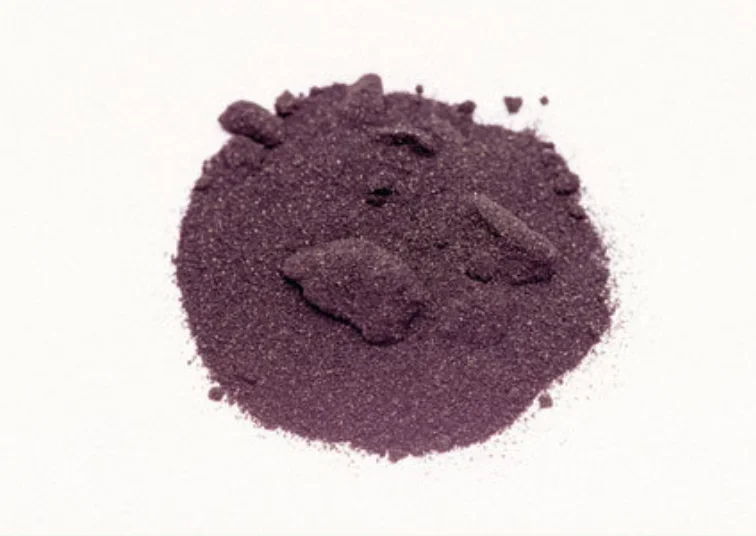
Side by side
| Potassium permanganate (KMnO₄) | Sodium permanganate (NaMnO₄) | |
|---|---|---|
| Form supplied | Dry crystals, ≥97% KMnO₄ | 40% liquid, dark purple |
| Maximum concentration in water | About 5% at room temperature (6.4 g per 100 mL at 20 °C) | 40% as supplied; dilutes to any strength |
| Permanganate per pound of product | 100% of the weight is KMnO₄; 0.75 lb of MnO₄⁻ per lb | 40% of the weight is NaMnO₄; 0.34 lb of MnO₄⁻ per lb of solution |
| Equivalent quantity | 1.00 lb | 0.90 lb of NaMnO₄, which is 2.25 lb of 40% solution |
| Cost | Lower per unit of oxidant | Higher per unit of oxidant; you pay for the water and the convenience |
| Handling | Dry oxidizer; dissolving tank or site-ready solution needed; dust control | Concentrated liquid oxidizer; tote and metering pump; stronger PPE and spill requirements |
| Water carried per lb of KMnO₄-equivalent | About 19 lb (2.3 gal) at 5% | About 1.4 lb (0.17 gal) at 40% |
| Soil blending and backfill | The standard choice: blends dry | Possible, but wet |
| Injection | Mixed on site to ≤5%, or delivered pre-mixed | Injected neat or diluted; no dissolving equipment |
| Cation added to the aquifer | Potassium | Sodium, which can raise the sodium adsorption ratio on sodium-sensitive soils |
| Packaging from Hepure | 55-lb pails, 330-lb drums; pre-mixed up to 5% in drums, totes and tankers | 55-gallon drums, 275-gallon totes, tankers; pre-diluted to 5% or 10%+ to order |
| Shipping class | Oxidizer, UN1490, Class 5.1 | Oxidizer, UN3214, Class 5.1 |
The same chemistry, in either form
In water both salts dissociate completely, and what reaches the contaminant is the permanganate ion. It oxidizes chlorinated ethenes to carbon dioxide, chloride and manganese dioxide without passing through the dichloroethene and vinyl chloride daughter products that a stalled biological remedy leaves behind, and it does the same work on many other organics. The stoichiometry is the same for both salts on a molar basis: 2 moles of permanganate per mole of TCE, 4/3 mole per mole of PCE. Converted to product weights:
| To oxidize 1 lb of | KMnO₄ (dry) | NaMnO₄ (100% basis) | 40% NaMnO₄ solution |
|---|---|---|---|
| TCE | 2.41 lb | 2.16 lb | 5.4 lb |
| PCE | 1.27 lb | 1.14 lb | 2.85 lb |
Those are theoretical minimums. The soil’s natural oxidant demand, reduced iron and manganese, and organic matter consume permanganate before the contaminant does, usually several times the contaminant’s own demand; the worked example and the demand discussion are on our permanganate for ISCO guide. Reaction rate rises with permanganate concentration, which is one practical argument for sodium permanganate in a source zone, and the oxidant stays active for weeks to months in the subsurface, which is why a single injection event treats a volume rather than a point.
To convert a design written for one salt to the other: multiply pounds of KMnO₄ by 0.90 to get pounds of NaMnO₄, or by 2.25 to get pounds of 40% solution; divide to go the other way. The molar masses are 158.03 g/mol for KMnO₄ and 141.93 g/mol for NaMnO₄.
When potassium permanganate is the better choice
Cost. Per pound of permanganate ion delivered, the dry salt is the cheaper product, and it ships without water: a 330-lb drum of KMnO₄ carries as much oxidant as about 740 lb of 40% sodium permanganate solution.
Soil blending and backfill. Dry crystals blend into excavated soil or into a mixing cell with a rotary tool and dissolve in the soil moisture; that is how manufactured gas plant and wood-treatment soils are usually treated.
Handling. Because KMnO₄ cannot be made into a solution stronger than about 5%, the strongest liquid on site is a 5% solution; there is no concentrated liquid oxidizer to store or pump. The dry product needs dust control and a dissolving tank, or it is delivered pre-mixed so no site mixing is needed.
Potassium-sensitive sites are rare; sodium-sensitive ones are not. Where the receiving soil is sodium-sensitive or the sodium adsorption ratio is monitored, potassium permanganate avoids the question.
When sodium permanganate is the better choice
Concentration. 40% solution carries roughly ten times the oxidant per gallon of a saturated potassium solution, so a program that needs a lot of oxidant in a small injection volume, or a source zone where a high concentration drives the reaction faster, is a sodium permanganate program.
No dissolving equipment. A tote and a metering pump replace a dry feeder and a dissolving tank. At a remote site, or a water treatment plant feeding permanganate continuously, that is the whole decision.
Water. Delivering a pound of KMnO₄-equivalent takes about 19 lb of water as 5% KMnO₄ and about 1.4 lb as 40% NaMnO₄. Where water has to be trucked, or where injection volume is limited by the formation, the liquid wins.
Speed to mobilize. Sodium permanganate is ready to inject as delivered, full strength or pre-diluted.
Packaging and delivery
Potassium permanganate ships as dry crystals in 55-lb pails and 330-lb drums, or pre-mixed up to 5% in 55-gallon drums and 275-gallon totes, with tankers above 3,000 gallons; the product page is here. Sodium permanganate ships at 40% in 55-gallon drums, 275-gallon totes and tankers, or pre-diluted to 5%, 10% and up, made to order; the product page is here. Both are supplied through distribution relationships positioned nationwide. Send Pat (West, x1) or Bob (East, x2) the design dose, the volume and the delivery address and you will have a quote for either form, usually within one business day: 866-727-4776 or the request form.
Common questions
Is sodium permanganate stronger than potassium permanganate?
No. The oxidant is the same ion. Sodium permanganate is more concentrated as supplied (40% versus a 5% maximum for potassium), which is a difference in delivery, not in oxidizing power per mole.
Can I substitute one for the other in an existing design?
Yes. Multiply pounds of KMnO₄ by 0.90 for pounds of NaMnO₄, or by 2.25 for pounds of 40% solution. Check the injection volume, since the water content changes, and check the sodium loading if the soil is sodium-sensitive.
Which one for soil mixing?
Potassium permanganate. It blends dry and dissolves in the soil moisture; the liquid can be used but adds water to the mix.
Which one for injection wells?
Either. Potassium permanganate is mixed to 5% on site or delivered pre-mixed; sodium permanganate goes in at any strength up to 40%. The decision is usually equipment and water: with no dissolving tank and limited water, sodium.
Which one for a water treatment plant?
Both are used for iron, manganese and sulfide oxidation. Dry feeders handle potassium permanganate; where the plant wants a liquid feed, sodium permanganate at 40% or pre-diluted. Our water treatment chemicals page covers the feed options.
Does the sodium matter?
At most remediation sites, no. Where soils are sodium-sensitive or the sodium adsorption ratio is a permit condition, it belongs in the discussion and can tip the choice to potassium.
Which one costs less?
Potassium permanganate, per unit of oxidant, because you are not buying and shipping the water. Sodium permanganate costs more per unit of oxidant and saves on equipment, labor and water; which total is lower depends on the site.
Request More Information
Send the design dose and volume and we will quote either form and the pre-mixed options.
Contact Us →