Sodium Hydroxide
Hepure is the premier supplier of remediation-grade sodium hydroxide for in situ chemical oxidation and enhanced bioremediation pH adjustment.
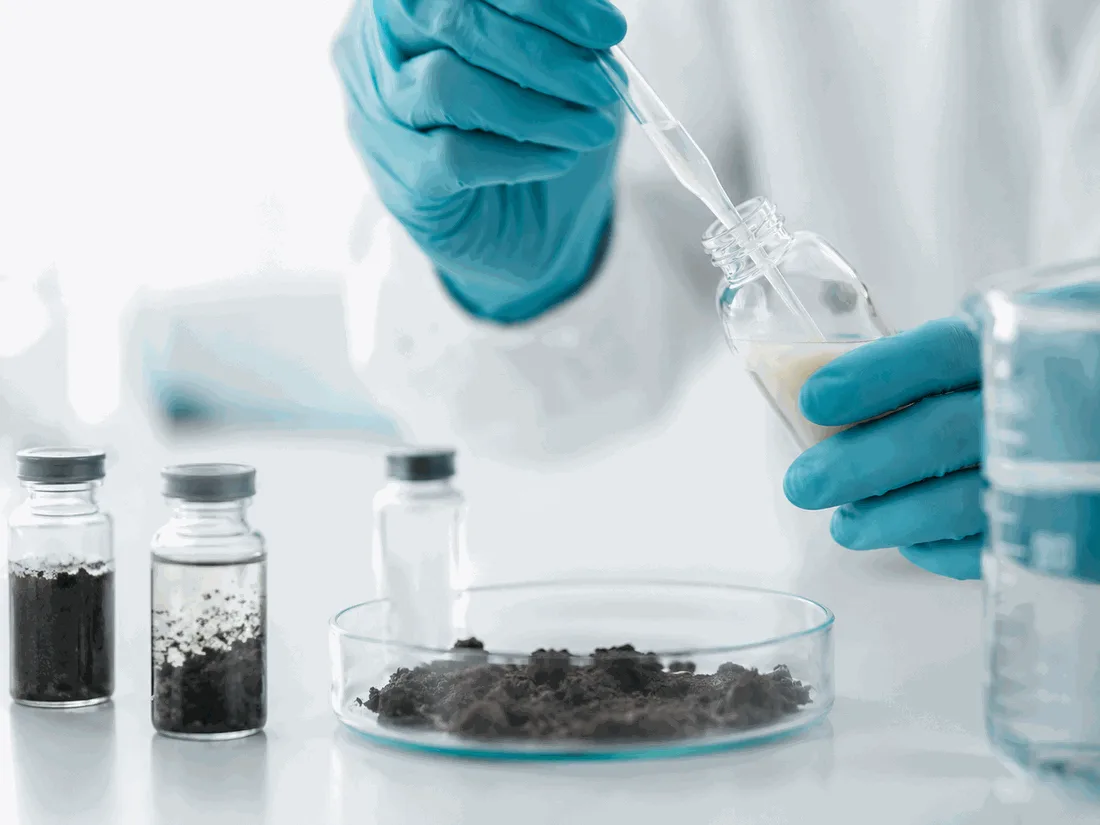
Sodium Hydroxide Supplier for Remediation
A good share of the sodium hydroxide calls we take start with “our usual supplier can’t deliver in time” — a program is mobilizing, the persulfate is ordered, and the activator is the piece that fell through. If that’s you: yes, we supply remediation-grade sodium hydroxide, we ship it through the same nationwide distribution as the rest of the line, and we can send it on the same order as the oxidant it’s activating.
Sodium hydroxide is an inorganic compound with the formula NaOH and a molecular weight of 40 grams per mole — the sodium cation and the hydroxide anion, which is what does the work. Hepure provides it as a 25% solution in 560-pound drums (55 gallons) and 2,400-pound totes (275 gallons), and as custom mixtures of any percentage. In remediation it does two jobs: raising the pH of acidic soils and aquifers so that other chemistries work, and alkaline activation of sodium persulfate.
What It Does on a Site
Sodium hydroxide is usually applied by injection before the bioremediation or chemical oxidation amendments go in. It diffuses through the aquifer and conditions it for what follows. Many remediation methods — bioremediation and chemical oxidation among them — work best when pH is brought into a more neutral range of roughly 6 to 9; and sodium persulfate is markedly more reactive when applied above pH 10.5, which is why alkaline activation with sodium hydroxide is the most common persulfate activation method in the field (the activator doubles as a buffer for the acid the persulfate reaction produces). It also matters after fast-fermenting electron donors like sodium lactate, which can depress pH in poorly buffered aquifers and slow the very bacteria they’re meant to feed.
Two secondary effects are worth knowing. At elevated pH, many heavy metals form insoluble hydroxide precipitates — the basis of hydroxide precipitation in wastewater treatment and a contributor to metals immobilization in soil. And raising pH can desorb some contaminants from soil particles, making them more available for degradation or removal. Both should be planned for rather than discovered.
Dosing Starts With a Buffering Test
The question is never “how much caustic” in the abstract — it’s how much this soil will absorb before its pH moves. Before field injection, a soil buffering test is run in the laboratory to determine the amount of sodium hydroxide needed to raise the pH to the target. Buffer capacity is the amount of acid or base a soil can take up before its pH starts to change significantly, and it varies a great deal from site to site.
Various minerals do the buffering. At high pH, calcium, magnesium, and potassium oxides, together with carbonates, resist further change; at acidic pH, aluminum oxides and iron hydroxides act as the buffering agents; at intermediate pH, soil organic matter, mineral weathering, and exchange reactions do the work. As a rule, clay soils have far higher buffer capacity than sandy soils, and higher organic matter content increases it. In practice that means the same target pH can call for several times more sodium hydroxide on a clay site than a sand site — which is why we ask for the buffering result, or the soil data to estimate it, before we size an order.
Handling
A 25% caustic solution is a strong base: it burns skin and eyes on contact, dilution generates heat, and it’s incompatible with aluminum and some other metals. Standard chemical PPE, compatible pumps and fittings, and the site health and safety plan cover it — but confirm the injection contractor’s wetted materials before the truck arrives, the same conversation we have about persulfate’s acid on the other end of the reaction. Wider context on the oxidant side is on our chemical oxidants page; the soil side on soil remediation.
Sodium Hydroxide for Water and Wastewater Treatment
Sodium hydroxide is the simplest pH tool in water treatment. It dissolves completely, feeds from a metering pump, and adds none of the undissolved solids a lime slurry brings. Raising pH neutralizes acidic water and turns dissolved metals into hydroxide solids that settle or filter out.
Industrial Wastewater
Neutralization and hydroxide precipitation are the backbone of metals treatment. Each metal has its own minimum-solubility pH, and in a mixed stream no single pH suits them all: zinc and lead start to redissolve at the high pH that nickel and cadmium need. Complexing agents from cleaners and plating baths also hold metals in solution at any pH. That’s why mixed-metal streams often pair caustic with a sulfide polish such as Remotox calcium polysulfide.
Mine Water
Lime is the cheapest alkali for large acid drainage flows, but caustic earns its place at small and remote sites, where a tote, a metering pump, and a pH controller replace a lime slaker and silo. In a West Virginia University cost comparison of acid mine drainage reagents, caustic had the lowest annualized cost for low-flow, low-acidity discharges. Iron and aluminum drop out between pH 6 and 8; manganese needs about pH 10 on alkali alone, or permanganate oxidation at near-neutral pH. Our 25% solution stays liquid at far lower temperatures than 50% caustic, which matters at an unheated site in January.
Stormwater
Where runoff is collected in tanks or lined ponds and treated in batches, caustic brings each batch to the pH your precipitation step needs before settling or filtration.
Drinking Water
pH adjustment for corrosion control in the distribution system, and for the coagulation and oxidation steps that depend on pH.
Supplying Sodium Hydroxide for Water Treatment
We ship a 25% solution in 560-lb drums (55 gallons) and 2,400-lb totes (275 gallons), or blend custom strengths to order. Caustic burns skin and eyes, attacks aluminum, and gives off heat when diluted, so confirm pumps, fittings, and dilution practice before the first delivery. See all Hepure water treatment chemicals.
Common Questions
Which concentration should I order? The 25% solution suits most injection programs and dilutes easily on site. If your design wants a different strength — or you’d rather not handle dilution in the field — we blend custom percentages to order.
How much do I need? From the buffering test, plus the activation requirement if persulfate is in the program. Send us the soil data and the persulfate quantity and we’ll turn it into a number.
Can it ship with the persulfate? Yes — that’s the usual order. One source, one delivery window, one CoA set for the oxidant and its activator. Call 866-727-4776 — Pat Randall (x1) in the West, Bob Kelley, Ph.D. (x2) in the East — or request more information.
Reference
- Cronk, G., Koenigsberg, S., & Schlott, D. (2010). Controlled Vadose Zone Saturation and Remediation (CVSR) Using Chemical Oxidation. Battelle 7th International Conference on Remediation of Chlorinated and Recalcitrant Compounds, May 24–27, 2010.
Request More Information
Contact our technical team for product specifications, custom quotes, and site-specific guidance.
Contact Us →