Calcium Polysulfide Remotox
A proven in situ chemical reduction technology for treating hexavalent chromium and other oxidized metals in soil and groundwater — reliably converting them to less toxic, less mobile forms.
What is Remotox?
Hepure has supplied calcium polysulfide to consultants for decades under the Remotox name, and most of the calls come from the same place: a hexavalent chromium site with a deadline. This page covers what Remotox is, exactly how the chemistry works on each metal, and how to get it into the ground.
Remotox is Hepure’s calcium polysulfide (CaSx) product — a water-soluble reducing agent that has proven cost-effective for in situ stabilization of metals in soil and groundwater. It is supplied as a 29% (wt.) CaS5 aqueous solution, and is used routinely for remediation of excavation sites and contaminated aquifers in the United States and abroad.
When mixed with water, Remotox dissociates into bisulfide, aqueous hydrogen sulfide, and other sulfur anions that react with heavy metals to form less soluble, non-toxic metal sulfides. Cation metals such as arsenic, lead, cadmium, and copper precipitate as sulfides; oxidized metals such as hexavalent chromium are reduced to trivalent chromium and precipitate as chromium hydroxide, Cr(OH)3 — stable across a wide range of naturally occurring geochemical conditions.
Effective treatment can be achieved over a wide pH range, with best results typically between pH 7 and 10; adjusting the pH of treatment liquids can enhance metals precipitation. Application and dosage depend on site-specific conditions — we say this on every call: run bench and pilot-scale testing to verify treatability before you size the order.
Remotox CaSₓ technical details
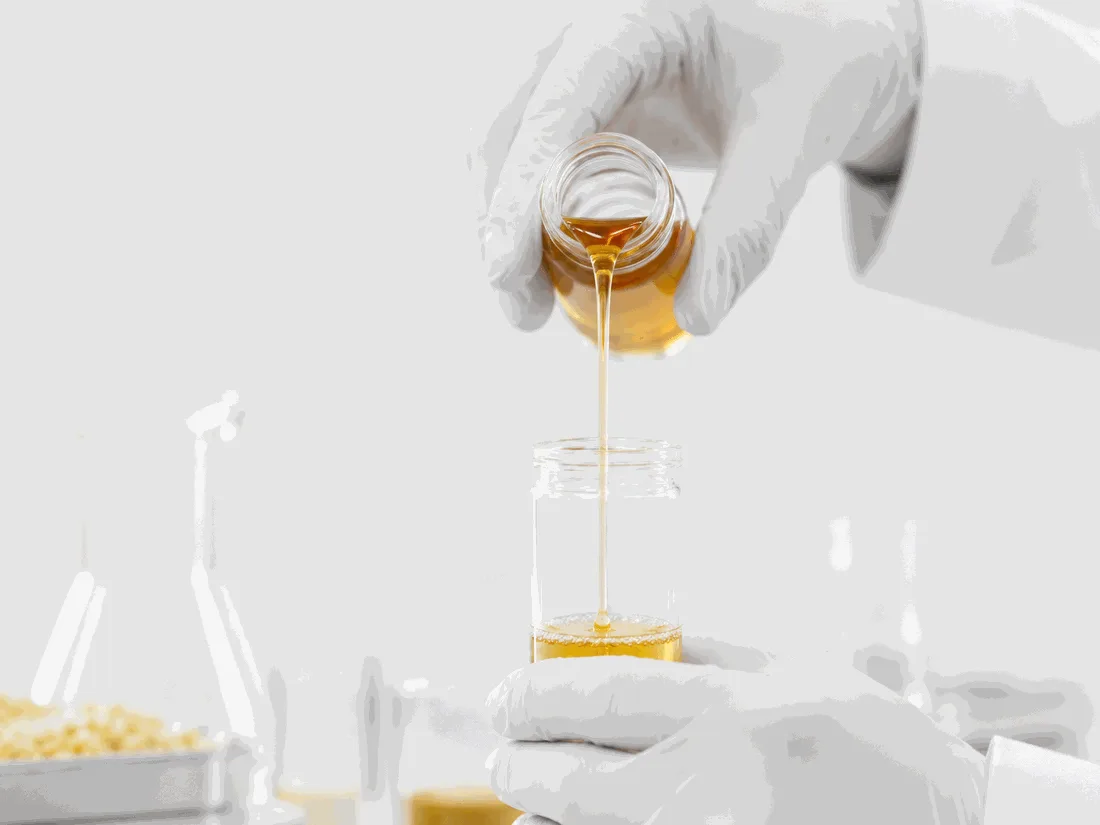
A concentrated aqueous calcium polysulfide solution ready for direct injection or dilution, depending on site requirements.
Remotox Calcium Polysulfide
Aqueous Reducing AgentWater-soluble and ready for direct injection or dilution. Bench and pilot-scale testing is recommended to confirm treatability and dose at your site — send us your data and we’ll help design the test.
The reduction chemistry
Calcium polysulfide provides a powerful, sustained source of reduced sulfur species that chemically reduce Cr⁶⁺ to Cr³⁺.
The full reaction set
Remotox reacts with oxygen and carbon dioxide in the subsurface to form calcium thiosulfate, hydrogen sulfide, elemental sulfur, and calcium carbonate:
Hexavalent chromium is then reduced to trivalent chromium by both the thiosulfate and the hydrogen sulfide. The sulfide of trivalent chromium is unstable in water and soil moisture, so it precipitates as chromium hydroxide instead:
Hexavalent chromium may also be reduced indirectly by ferrous iron, produced when calcium polysulfide reduces the ferric iron naturally present in soils — the same pathway that makes ferrous sulfate and zero valent iron complementary chemistries on chromium sites.
Electron Transfer
Polysulfide ions (Sₓ²⁻) donate electrons to Cr⁶⁺, reducing it to Cr³⁺. This changes chromium from a highly soluble, carcinogenic form to a low-solubility, low-toxicity precipitate.
Precipitation
Trivalent chromium precipitates as Cr(OH)₃ — a stable, insoluble solid that remains immobilized in the soil matrix under normal environmental conditions.
Sustained Reduction
Excess polysulfide creates a reducing buffer zone in the subsurface that continues to treat chromium migrating into the treated area, providing long-term protection.
Where Remotox excels
Calcium polysulfide is effective across a range of site conditions and delivery methods.
Direct-Push Injection
The primary application: a Remotox slurry injected into direct-push borings (Geoprobe or similar), with solution strength varied by depth and location to ensure contact with the contaminant plume.
Infiltration
Surface or shallow infiltration to deliver reductant to affected soils — including precautionary treatment that creates a barrier against vertical migration of hexavalent chromium.
Soil Mixing and Backfill
Remotox mixed directly with contaminated soil, which is then placed as backfill or hauled for disposal — a straightforward fit for excavation projects.
Boreholes and Excavation Placement
Placed in drilled boreholes to create a reactive barrier, or in the bottom of an excavation that has penetrated the saturated zone, to treat groundwater entering the excavated area.
One field note: the chemistry that makes Remotox work releases hydrogen sulfide as it reacts. Plan ventilation and monitoring for excavation work accordingly — the health and safety plan should account for it before the first drum opens.
References
- Voluntary Cleanup Report, Cross Manufacturing, Inc. — Lewis, Kansas, December 17, 2015
- Groundwater Resources Association of California, Hydro Visions, Vol. 10, No. 2, Summer 2001
Beyond chromium
Chromium reduction is the primary application, but the same sulfide chemistry precipitates a range of other metals. Effective pH ranges and the products formed, from Hepure’s field guidance:
| Metal | Effective pH | Product formed |
|---|---|---|
| Hexavalent chromium (Cr6+) | Wide range | Reduced to Cr3+, precipitates as Cr(OH)3 |
| Arsenic (As) | Acidic (pH < 7) | Arsenic sulfides — soluble above pH 7, insoluble below |
| Lead (Pb) | 4 – 9 | Lead sulfide (PbS) |
| Copper (Cu) | 5 – 7 | Copper sulfide (CuS) |
| Zinc (Zn) | 4 – 9 | Zinc sulfide (ZnS) |
| Cadmium (Cd) | 4 – 9 | Cadmium sulfide (CdS) |
| Molybdenum (Mo) | 4 – 9 | Molybdenum disulfide (MoS2) |
| Uranium (U) | 4 – 9 | Uranium dioxide, uraninite (UO2) |
| Cyanide | — | Converted to thiocyanate, which can be bio-treated or lime-treated (yielding calcium carbonate, gypsum, and ammonia) |
Injected into a contaminated aquifer, Remotox drives precipitation of cations as sulfides — FeS, ZnS, PbS, CdS, CuS — while chromium, unlike the others, precipitates as hydroxide. For broader metals strategy, see our metals treatment overview.
Remotox for Water and Wastewater Treatment
The sulfide chemistry that stabilizes metals in an aquifer precipitates them in a tank.
Industrial Wastewater
One dose reduces hexavalent chromium and precipitates other metals as sulfides, which suits mixed-metal streams from plating, finishing, and manufacturing. Metal sulfides are far less soluble than the matching hydroxides, so a sulfide step after hydroxide precipitation reaches lower effluent levels and pulls out metals that weak complexing agents hold in solution.
Mine Water
Polishes lead, zinc, cadmium, and copper below what neutralization alone reaches, at lower pH than hydroxide precipitation needs. Our field guidance puts effective ranges at pH 4 to 9 for lead, zinc, and cadmium and pH 5 to 7 for copper. It isn’t a neutralizer: lime or caustic does the bulk work first.
Industrial Stormwater
At scrap yards, metal facilities, and salvage operations that collect runoff in tanks or lined ponds, batch dosing precipitates dissolved zinc, copper, and lead before settling or filtration. It’s a batch chemistry, not a filter media.
Dosing in a Tank
More isn’t better. Excess polysulfide can form soluble complexes that redissolve copper, zinc, nickel, and cadmium, so control the dose by ORP or bench results. Cover and ventilate the tank: the reaction releases hydrogen sulfide, more so as pH drops.
Remotox ships as a 29% calcium polysulfide solution in pails, drums, totes, or tankers. Send your treatment volume and dose, and we’ll match packaging and delivery to them. See all Hepure water treatment chemicals.
Remotox, answered
Is Remotox the same as calcium polysulfide?
Yes. Remotox is the name Hepure’s calcium polysulfide (CaS5) has carried for decades. If your spec says “calcium polysulfide, 29% solution,” this is the product.
How is it supplied?
As a 29% aqueous solution in pails, drums, totes, or tankers for larger programs. Tell us your treatment volume and we’ll match the packaging to it.
Do I need bench testing?
We recommend it every time. Dose depends on the metals present, their concentrations, and site geochemistry — a bench test turns an estimate into a number you can defend. Send site data to Pat Randall (West, x1) or Bob Kelley, Ph.D. (East, x2) at 866-727-4776, or request more information.