Sodium Lactate
Hepure is a premier sodium lactate supplier. Our sodium lactate is an electron donor used to stimulate anaerobic reductive dechlorination of chlorinated solvents.
Sodium Lactate Supplier for Anaerobic Bioremediation
When a consultant calls about sodium lactate, the question is rarely “does it work” — it’s “how fast, how long, and what do I pair it with.” Here’s the short version we give on the phone: lactate is the jump-start, emulsified vegetable oil is the long haul, and most chlorinated solvent programs want both.
Sodium lactate is an inexpensive, water-soluble, food-grade, fast-acting substrate that rapidly establishes the reducing conditions needed to biodegrade chlorinated solvents. Because it is so readily bioavailable, it has a short lifetime after injection — which is precisely why it’s so often combined with a longer-lasting substrate like emulsified vegetable oil (EVO): the lactate jump-starts the bacterial population while the EVO supplies carbon and hydrogen to sustain dechlorination over months. It is non-toxic and biodegradable, and can be applied by injection or infiltration.
How Anaerobic Bioremediation Works
The anaerobic bioremediation process uses microorganisms to degrade chlorinated solvents such as tetrachloroethene (PCE) and trichloroethene (TCE). An organic substrate is added to the groundwater to generate reducing conditions and provide the carbon and hydrogen the process needs. Under anaerobic conditions, microorganisms ultimately metabolize organic contaminants to methane, limited carbon dioxide, and trace hydrogen gas; bacteria gain energy and grow as an atom on the contaminant is replaced with hydrogen.
Anaerobic metabolism spans many processes — fermentation, methanogenesis, reductive dechlorination, sulfate- and iron-reducing activity, and denitrification — and a given site will see a subset of them depending on the contaminant of concern. In each, nitrate, sulfate, carbon dioxide, oxidized metals, or organic compounds such as chlorinated hydrocarbons replace oxygen as the electron acceptor. The hydrogen used in the reaction is typically supplied indirectly, through fermentation of the organic substrate — which is exactly what sodium lactate provides, quickly.
Sequential Dechlorination
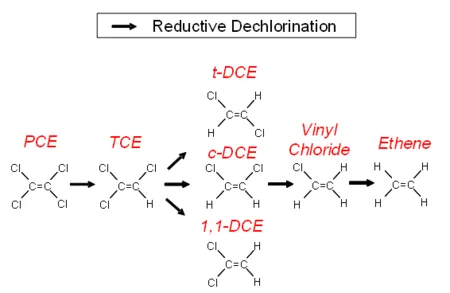
Anaerobic conditions are generally used to degrade highly halogenated contaminants (some petroleum hydrocarbons can also be biodegraded anaerobically). The halogenated compound — typically a chlorinated solvent such as PCE, TCE, 1,1,1-trichloroethane (TCA), carbon tetrachloride, chloroform, or methylene chloride, or their degradation products DCE, vinyl chloride, dichloroethane, and chloroethane — serves as the electron acceptor, while hydrogen serves as the direct electron donor. Chlorinated solvents can exist and migrate in multiple phases — vapor in unsaturated soils, dissolved in groundwater, and as non-aqueous phase liquid (NAPL); most are denser than water and hydrophobic.
Chloride ions are removed sequentially: PCE to TCE to cis- or trans-DCE to vinyl chloride to the final product, ethene. Hydrogen is oxidized while the chlorinated ethene is reduced — and hydrogen is generally the most important electron donor for anaerobic dechlorination. One point that matters for design: the more highly chlorinated compounds (PCE, TCE) dechlorinate more readily than the partially reduced ones (DCE, VC). Run out of donor mid-sequence and the plume stalls at vinyl chloride — the reason sustained donor supply, not just an initial dose, is the whole design question.
A Practical Note on pH
Because lactate ferments fast, it produces acids fast. In a well-buffered aquifer that’s a non-event; in a poorly buffered one, pH can drop enough to slow the very bacteria you’re feeding. Check alkalinity in your site data, and if the numbers are thin, plan buffering — sodium hydroxide is the standard adjustment, and we’ll quote it alongside the lactate.
Sodium Lactate for Mine Water Treatment
Lactate is a classic food source for sulfate-reducing bacteria, and it’s the fast start in biological treatment of mine-impacted water. Bacteria ferment it within days, using up oxygen and nitrate first, then reducing selenate and sulfate; the sulfide from sulfate reduction precipitates dissolved metals. Researchers working with coal mining-influenced water have used lactate as the electron donor to grow native selenium-reducing bacteria, and several sediment cultures removed more than 90% of dissolved selenium within 72 hours in the lab.
Where Lactate Fits
Startup of bioreactors and in situ treatment zones, bench and pilot work, and short programs. It’s consumed within weeks, so long-running systems pair it with emulsified vegetable oil or another slow-release donor. Lactate also ferments to acids quickly; in poorly buffered mine water, plan pH support. Sodium hydroxide ships on the same order.
Supplying Sodium Lactate
We ship sodium lactate as a 60% solution in 605-lb drums (55 gallons) and 3,025-lb totes (275 gallons). It’s food grade, non-toxic, and biodegradable. See all Hepure water treatment chemicals.
Common Questions
Sodium lactate or EVO? Usually both. Lactate acts within days and is consumed within weeks; EVO takes longer to get going and lasts for months to years. Lactate alone suits short programs and bench-to-pilot work; EVO alone suits patient, long plumes; together they cover the whole curve. Where you want iron chemistry in the same injection, Ferox Plus (eZVI) combines ZVI with an EVO-based donor.
Which contaminants does it treat? The chlorinated solvent family — PCE, TCE, TCA, carbon tetrachloride, chloroform, and their daughter products (see CVOC remediation) — plus other contaminants that degrade under reducing conditions, such as nitrate and sulfate.
How is it supplied? As a 60% solution in 55-gallon drums (605 lb) or 275-gallon totes (3,025 lb). Tell us your injection volume and we’ll size the order — call 866-727-4776 (Pat Randall x1, West; Bob Kelley, Ph.D. x2, East) or request more information. The full amendment line is on our bioremediation amendments page.
Reference
- AFCEE, NFESC & ESTCP. (2004). Principles and Practices of Enhanced Anaerobic Bioremediation of Chlorinated Solvents. Naval Facilities Engineering Service Center, Port Hueneme, California.
Request More Information
Contact our technical team for product specifications, custom quotes, and site-specific guidance.
Contact Us →