Ferox PRB
Hepure’s Ferox PRB reactive zero valent iron was exclusively designed for groundwater and soil remediation in permeable reactive barriers.
Overview
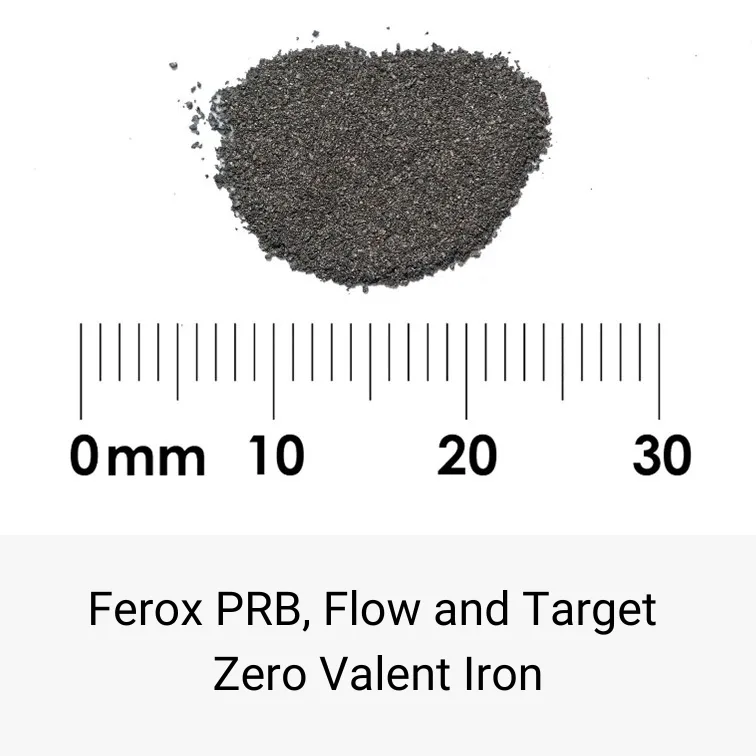
Ferox PRB has uniform delivery characteristics and mesh size while being free of rust, dust, and potentially harmful lubricating oils. The result: better reactivity, providing a more effective and efficient remediation solution. Hepure’s ZVI is extremely pure — from the selection of raw materials through manufacturing and packaging, all processes satisfy demanding product standards. Quality assurance testing is performed at every stage of production so product consistency is maintained.
Ferox PRB for Water Treatment
Ferox PRB was built for permeable reactive barriers, and the properties that make it work in the ground make it a clean reactive media above ground too: more than 95% iron, 96% of the particles within 20/60 mesh, and no rust, dust, or oil. Zero valent iron works two ways. It reduces oxidized contaminants such as selenate, and the iron oxides that form as it corrodes adsorb others, phosphate among them.
Mine Water: Selenium
ZVI reduces selenate and selenite to insoluble elemental selenium and iron selenides, which is why it shows up in so much selenium treatment research. In anoxic batch tests on synthetic mine water, 90% of selenate was gone in 1.5 hours with no competing ions, while 1,800 mg/L of sulfate stretched that to 33 hours. A Québec study took a real mine effluent below the 0.5 µg/L detection limit at a 1.25% solids-to-liquid ratio and eight hours of contact. Field pilots add a caution: iron released from the media can carry selenium out with it unless a downstream filter catches the iron. Results depend on the water, so engineers bench-test ZVI on the actual water before sizing a reactor.
Granular ZVI also serves as the reactive media in permeable reactive barriers that intercept seepage from waste rock and tailings. One caution for nitrate-bearing water: ZVI reduces nitrate mostly to ammonium, which can trade one discharge limit for another.
Stormwater: Dissolved Phosphorus
Iron-enhanced sand filtration, sometimes called the Minnesota filter, mixes metallic iron into a sand filter. Between storms the iron rusts, and the iron oxides capture dissolved phosphate, which ordinary sand filters pass and which averages about 45% of total phosphorus in urban runoff. In University of Minnesota column tests, sand with 5% iron by weight captured an average of 88% of phosphate with no loss of hydraulic conductivity, and the Minnesota Stormwater Manual calls for 5% to 8% iron, sized to match the sand. Ferox PRB’s 20/60 mesh sits within the size range of common filter sands. The filter has to drain and dry between storms so the iron stays oxidizing, and it needs pretreatment upstream so sediment doesn’t blind it.
For dissolved copper and zinc in stormwater, the published evidence favors organic amendments such as biochar; iron should be tested on the actual runoff before anyone counts on it for metals.
Supplying Ferox PRB for Water Treatment
Tell us the media volume, the gradation of the sand or media it’s going into, and your schedule, and we’ll quote it. See what ZVI treats for the full contaminant list. See all Hepure water treatment chemicals.
Request More Information
Contact our technical team for product specifications, custom quotes, and site-specific guidance.
Contact Us →