Zero Valent Iron Remediation
How ZVI treats chlorinated solvents and metals in soil and groundwater, how particle size decides where it can go, and how it gets into the ground. Written by the people who have supplied Ferox iron to remediation sites since 2000.
What zero valent iron does in the subsurface
Zero valent iron (ZVI) is metallic iron in its elemental, uncharged state. In the subsurface it is a reductant: it gives up electrons to whatever it touches, and a long list of contaminants accept them. Chlorinated solvents such as TCE and PCE are dechlorinated abiotically, which matters because the reaction skips the biological pathway that produces cis-DCE and vinyl chloride as intermediates. Hexavalent chromium is reduced to the far less soluble trivalent form. Arsenic, nitrate, sulfate, nitroaromatics, and several other metals and inorganics are reduced, precipitated, or sorbed onto the iron corrosion products that form as the ZVI works.
Granular iron has been used in permeable reactive barriers (PRBs) since the mid-1990s. Micron- and nano-scale iron came later: the smaller the particle, the more surface area per pound and the faster the reaction, and small particles can be injected into a formation rather than placed in a trench. That is what opened up source-zone and plume treatment at depth, in places where a barrier is not practical.
Since entering the remediation market in 2000, Hepure’s Ferox powders have become the most widely used micron-scale iron powders in North America, with documented outcomes at more than 150 sites. In 2022 alone, nearly 1,000 tons of Ferox went to more than 15 projects in the US and overseas. Ferox is produced from high-quality cast iron feedstock and proprietary catalytic iron powders, manufactured for remediation rather than repurposed from another industry.
Why particle size decides everything
Particle size is the single design choice that determines whether ZVI will stay where you put it, reach where you need it, and last as long as the plume. The rules of thumb below come from three decades of field work and are the starting point for any conversation with our technical team.
| Application | Typical particle size | Why |
|---|---|---|
| Permeable reactive barrier | Greater than 60 mesh (250 micron); 90% of particles above 100 mesh | Must mix with backfill and stay suspended without separating during placement. Particles above 20 mesh add little reactivity and are not needed. |
| Plume injection | 100 to 400 mesh (37 to 150 micron) | Easier pre-injection mixing and suspension, better flow through the soil matrix, larger radius of influence, with a balance of reactivity and longevity. |
| Source-area treatment | 400 mesh and finer (under 37 micron) | Highest reactivity where contaminant mass is concentrated. |
The distribution of sizes should be narrow. Oversized particles react slowly and can make up a disproportionate share of the mass you paid for; undersized fines react fast and can exhaust the iron before the plume is gone. Hepure publishes the size ranges for each Ferox grade and can walk you through the measurement methods used to specify them.
Engineered iron versus repurposed iron
Steel shot, steel grit, cast iron aggregate, and ballast were made for blasting and weighting, not for groundwater. Repurposed material of this kind often carries impurities and alloying metals that do nothing for reactivity or longevity, and the particles are typically spherical from their previous life, which limits surface area per pound. Iron manufactured for remediation delivers a consistent reactivity and a predictable life in the ground. When you compare quotes, compare the iron content, the shape, and the size distribution, not just the price per ton.
Delivery: how ZVI gets into the ground
Because treatment depends on contact between an iron particle and a contaminant molecule, how far the iron travels from the injection point is as important as what the iron can do. Four delivery approaches cover most sites.
Permeable reactive barriers
Granular Ferox PRB is mixed with sand and placed in a trench or borehole array across the flow path of a plume. Groundwater passes through under its own gradient and is treated as it goes. Barriers are the lowest-maintenance ZVI application and the longest-lived, typically designed for a decade or more. Our PRB design page covers sizing, iron demand, and longevity.
Direct-push injection
Small-diameter hollow steel rods are hydraulically advanced to the target depth and the iron slurry is pumped through them. Direct push is effective and economical at shallow depths, generally within 50 feet of grade, and becomes slow and costly in deep or rocky ground. Two tool configurations are used. An expendable tip drops out of the lead rod and the slurry is injected bottom-up as the rods are withdrawn; it is simple but tends to push material down rather than out, so distribution is limited. A horizontal injection tool with side ports lets the operator inject top-down or bottom-up and pushes the iron outward, which is why it is the usual recommendation.
Hydraulic and pneumatic fracturing
In tight soils and weathered bedrock, the slurry is injected at a pressure that briefly exceeds the weight of the overlying soil and water plus the cohesive strength of the formation. A fracture opens, the iron is emplaced in it, and lateral distribution from a single point increases well beyond what pore-space injection achieves. Hydraulic fracturing uses the slurry itself, and more viscous slurries propagate fractures further. Pneumatic fracturing uses bursts of high-pressure gas, first to open the formation and then to carry the reagent; nitrogen is used with reducing reagents like ZVI so that oxygen is not pushed into the aquifer. Pneumatic methods have been applied in sands, silts, silty clays, and fractured rock to depths of about 160 feet.
Injection wells
Very fine iron (finer than 400 mesh) can be delivered through purpose-built injection wells screened only across the interval to be treated. Nested wells reach thick aquifers and DNAPL pooled at the base of an aquifer. Monitoring wells should be used for injection only when they are outside the compliance network, screened in the right interval, and tested to hold the injection pressure.
One rule applies to every method: keep the iron away from oxidants before and during injection. Oxidants strip reactivity from the iron, and the reaction between them is strongly exothermic.
Before you inject: the three-stage feasibility check
ZVI injection is one of the more expensive in situ techniques per pound of reagent, and the radius of influence is limited, so the sites that succeed are the ones that do the preliminary work. Consultants we work with generally follow three stages.
1. Conceptual site model. Contaminated soil volume and depth set the injection depths, spacing, and volumes. The mass of contaminant, competing electron acceptors (nitrate, sulfate, dissolved oxygen, ferric iron), and the native electron donors set the iron demand. Hydraulic conductivity, groundwater velocity, and flow direction set the achievable radius of influence, the volumes that can be injected, and the number of points.
2. Laboratory tests. Batch tests on aquifer samples give degradation kinetics and stoichiometry; column tests give mobility; sedimentation tests show whether the slurry stays suspended long enough to place. Together they confirm whether an iron application is feasible at that site at all.
3. Field pilot. No lab test reproduces an aquifer. A pilot injection establishes the workable injection pressure, flow rate, and radius of influence, exposes rebound, and lets you set a realistic remediation target before committing to the full program.
Hepure’s role in this sequence is the one a supplier should have: we provide the Ferox grade and particle-size data the design needs, estimate iron quantities from your site parameters, and tell you plainly when a different chemistry would serve the site better.
The Ferox product line
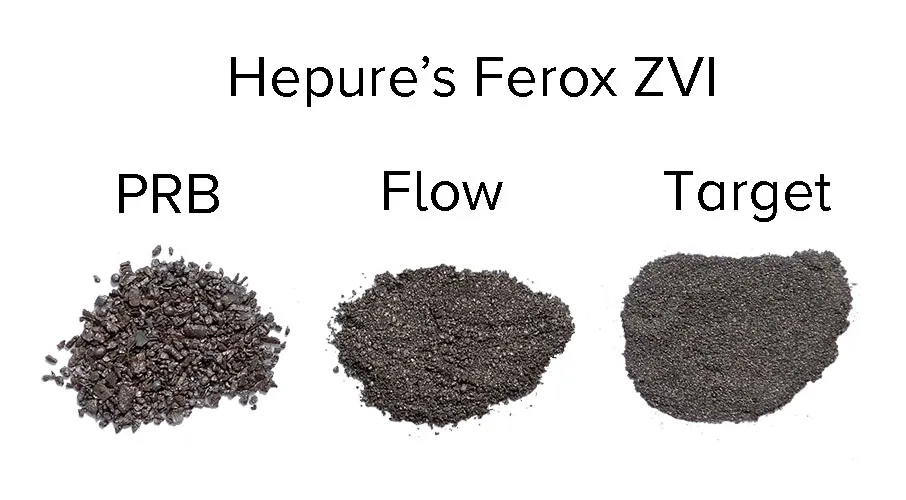
- Ferox PRB: granular 20/60 mesh iron, over 95% iron content, free of rust, dust, and oils, for permeable reactive barriers.
- Ferox Flow: fine, highly reactive powder engineered for injection into and downgradient of source zones, with the distribution and longevity a plume treatment needs.
- Ferox Target: fast-reacting powder for source areas and high-concentration zones.
- Ferox Plus (eZVI): Ferox iron emulsified with vegetable oil and nutrients, so a single injection drives abiotic reduction and anaerobic bioremediation together.
Full specifications, grades, and packaging are on the Ferox zero valent iron page. For the list of contaminants ZVI addresses, see what can be treated with ZVI, and for a worked example of a barrier that stopped a cis-DCE and vinyl chloride plume, read our ZVI chemistry and PRB case study.
Common questions
Does ZVI produce vinyl chloride? Abiotic reduction by ZVI proceeds mainly through beta-elimination, which bypasses the sequential dechlorination that builds up cis-DCE and vinyl chloride. Sites that combine ZVI with anaerobic bioremediation (Ferox Plus) still rely on the biological pathway for part of the treatment, so monitoring for daughter products remains part of the plan.
How long does injected iron last? Field longevity depends on particle size, iron demand from the geochemistry, and groundwater flux. Granular barriers are designed for a decade or more; injected micron-scale iron is typically expected to remain reactive for 3 to 15 years. Our technical team estimates longevity from your site data rather than quoting a single number.
Is ZVI affected by soil oxidant demand? No. Soil oxidant demand is a constraint on chemical oxidants. ZVI’s equivalent is reductive demand from competing electron acceptors, which the conceptual site model accounts for.
Can ZVI be combined with other chemistries? Yes. ZVI pairs naturally with electron donors (emulsified vegetable oil, sodium lactate) for enhanced reductive dechlorination, and ZVI zones are often placed downgradient of an oxidant application to polish what the oxidant leaves behind, provided the two are kept apart in time and space.
References
- Labeeuw, V. (2013). In Situ Chemical Reduction using Zero Valent Iron injection: a technique for the remediation of source zones.
- Fu, F., Dionysiou, D. D., & Liu, H. (2014). The use of zero-valent iron for groundwater remediation and wastewater treatment: a review. Journal of Hazardous Materials, 267, 194–205.
- U.S. EPA (1998). Permeable Reactive Barrier Technologies for Contaminant Remediation, EPA/600/R-98/125.
- Los Angeles Regional Water Quality Control Board (2009). Technical Report: Subsurface Injection of In Situ Remedial Reagents (ISRRs).
Request More Information
Send us your contaminant, depth, and soil type and we will recommend a Ferox grade and estimate the quantity.
Contact Us →