Zero Valent Iron (ZVI) Powders
Hepure supplies Ferox zero valent iron powders for soil and groundwater remediation and for water treatment, from one-pound lab samples to 40,000-lb containers.
Zero Valent Iron Supplier
Orders for zero valent iron come to us at every scale. We have shipped one pound for a bench test and more than 4,000,000 pounds for a single project, and both took the same thing: knowing what the project needs and lining up the trucking to match. In 2022, nearly 1,000 tons of Ferox went to more than 15 projects in the U.S. and overseas.
Small projects ship from domestic stock. For large programs we import full 40,000-lb containers into whichever port is closest to the site, domestic or international, which cuts the trucking cost of the last leg.
Ordering Ferox zero valent iron from Hepure
- Samples: 1 lb and 5 lb
- Pilot tests: 40-lb pails, 100-lb bags or 1,000-lb barrels
- Projects: drums or buckets (50 kg / 100 kg) and 2,205-lb super sacks; full 40,000-lb containers for large programs, delivered to the nearest port
- Quote: send the quantity, the application and the delivery address to Pat (West, x1) or Bob (East, x2) at 866-727-4776, or use the request form. We respond within one business day.
What Is Zero Valent Iron?
Zero valent iron (ZVI) is metallic iron, Fe0, sold as a powder or a granule. In water it corrodes, and as it corrodes it gives up electrons. Chlorinated solvents such as PCE and TCE take those electrons and lose their chlorine. Hexavalent chromium takes them and drops out of solution as trivalent chromium. Put iron where the contaminated water is, and the iron does the chemistry.
It gets there one of four ways: trenched into a permeable reactive barrier, injected as a slurry, mixed into soil, or injected as an emulsion with vegetable oil (eZVI). Particle size decides which. Our zero valent iron remediation guide covers how size and delivery method are chosen.
Which Ferox Grade Do You Need?
| Grade | Particle size | Placed by | Where it is used |
|---|---|---|---|
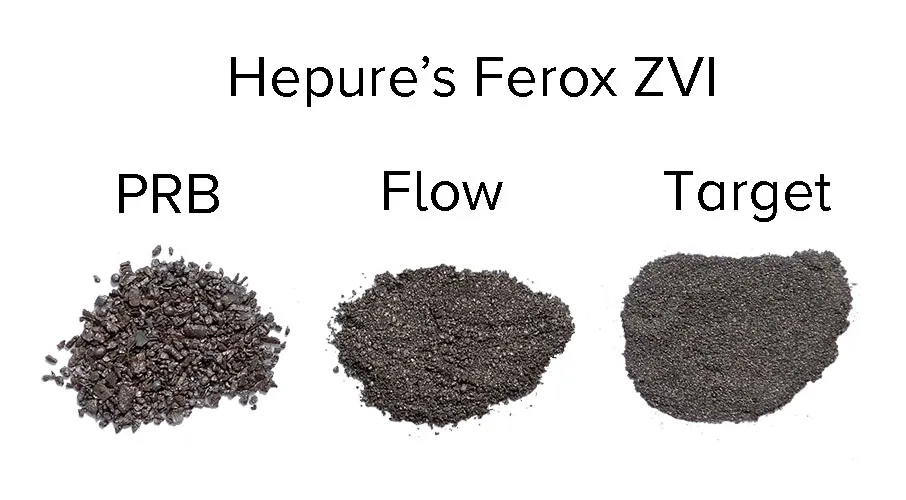
| Ferox PRB | Granular, 20/60 mesh | Trenching, soil mixing | Permeable reactive barriers; filter and reactor media for water treatment |
| Ferox Flow | About 125 microns (−100/+325 mesh) | Slurry injection, soil mixing | Plumes and source areas; the general-purpose injection grade |
| Ferox Target | About 44 microns (−325 mesh) | Slurry injection | Source areas and high concentrations, where reaction speed matters more than treatment life |
| Ferox Plus (eZVI) | Ferox Flow in a vegetable oil emulsion | Injection, ready to use | Source areas where the design wants iron and electron donor together |
Coarser iron lasts longer and finer iron reacts faster. Most grade decisions come down to that trade and to what the injection equipment can pump. Tell us the delivery method and we can usually name the grade in one phone call. For how the sizes are measured, see Ferox particle sizes.
Why Consultants Specify Ferox
By our count Ferox has gone into more than 150 sites across North America. These are the reasons we hear most.
- Long service from one placement. Our published range is 3 to 15 years, depending on the grade and the groundwater chemistry.
- Fewer daughter products. Iron’s abiotic reaction mostly bypasses cis-DCE and vinyl chloride, the intermediates where biological dechlorination can stall.
- No soil oxidant demand. Iron is a reductant, so the natural organic matter that eats an oxidant dose does not consume it. Dissolved oxygen, nitrate and sulfate do use up iron, and the designer accounts for them.
- Works with bioremediation. Corroding iron lowers the redox potential and gives off hydrogen, the conditions dechlorinating bacteria need. That is the idea behind Ferox Plus.
- Simple to ship and handle. Ferox is not classified as hazardous and is not regulated for transport. Keep it dry.
- Recycled feedstock. Ferox is ground from cast iron cuttings that would otherwise go to landfill.
Quality: Not All Iron Powders Are the Same
Ferox is produced from cast iron feedstock by a proprietary grinding and pulverizing process, with quality assurance testing at every stage from raw material to packaging. The powders ship free of rust, dust and cutting oil. Here is Ferox PRB against a competing barrier iron:
| Analysis | Hepure Ferox PRB | Competing barrier iron |
|---|---|---|
| Mesh size: 20/60 | 96% | 84% |
| Mesh size: finer than 60 | 4% | 16% |
| Iron | 95.48% | 94.36% |
| Sulfur | 0.08% | 0.56% |
| Carbon | 2.10% | 2.13% |
| Density (g/cm³) | 2.92 | 2.8 |
| Color | Gray metallic | Black metallic |
| Oil | 0%. No oil smell, none visible under the microscope | 1%. Oil smell, oil visible under the microscope |
Reactivity differs between irons too. In the TCE degradation tests reported on our specification sheets, Ferox Flow’s rate constant per gram of iron was about four times that of the commercial powder tested beside it, and Ferox Target’s rate constant per square meter of iron surface was more than twice that of the two powders it was tested against.
After evaluating ZVI powders in column experiments in his laboratory, Dr. Paul G. Tratnyek, Professor at Oregon Health & Science University and a leading researcher on reactive iron, noted that the TCE degradation rates were “surprisingly consistent with previously published work,” and that “Ferox Flow gave the most favorable results of the ZVIs tested in this study.”
How Iron Reduces Chlorinated Solvents
Zero valent iron reduces chlorinated compounds to non-chlorinated products. The general reaction, where R is the organic group:
2 Fe0 + R–Cl + 3 H2O → 2 Fe2+ + R–H + 3 OH− + H2 + Cl−
The reduction runs by three routes: (1) directly at the metal surface in the presence of a proton donor; (2) through further oxidation of Fe2+ to Fe3+; and (3, 4) by reaction with the hydrogen gas produced as iron corrodes in water.
(1) Fe0 + R–Cl + H+ → Fe2+ + R–H + Cl−
(2) 2 Fe2+ + R–Cl + H+ → 2 Fe3+ + R–H + Cl−
(3) Fe0 + 2 H2O → Fe2+ + H2 + 2 OH−
(4) H2 + R–Cl → R–H + H+ + Cl−
Iron also reacts with dissolved oxygen (5), with water (3) and with other oxidized species such as nitrate and sulfate, and an estimate of how much iron a site needs has to count them. Our barrier page works through how much iron a permeable reactive barrier needs.
(5) 2 Fe0 + 4 H+ + O2 → 2 Fe2+ + 2 H2O
Iron removes contaminants two more ways. Metals adsorb onto the iron corrosion products at the particle surface, and the anaerobic conditions iron creates encourage the microorganisms that drive further biological degradation. Our ZVI PRB case study shows a barrier doing all three.
Zero Valent Iron for Water Treatment
Not every order goes into the ground. Engineers also ask us for iron as reactive media for above-ground treatment: packed beds and columns for selenium in mine water, iron-enhanced sand filters for dissolved phosphorus in stormwater, and iron-carbon microelectrolysis reactors for industrial wastewater.
Granular Ferox PRB is the usual choice for a packed bed or a filter, because a fine powder packs tight and chokes the flow. Its 20/60 mesh sits in the size range of common filter sands. The Ferox PRB page covers the selenium and phosphorus applications and the published results behind them.
Media is often specified by volume. To convert, use the bulk density: Ferox PRB runs about 182 lb per cubic foot, Ferox Flow 167 and Ferox Target 143.5, so five cubic feet of Ferox PRB is roughly 910 lb. Send us the bed volume or the daily flow, the contaminant and the gradation your vessel is built for, and we will quote it. See all Hepure water treatment chemicals.
Common Questions
Which iron powder is used for water treatment and groundwater remediation?
Cast iron powders and granules such as Ferox. Granular grades like Ferox PRB go into barriers, filters and packed beds. Fine powders like Ferox Flow and Ferox Target are injected as slurries.
How much can you supply, and how fast?
One pound to millions of pounds, from domestic stock or imported containers. Lead time depends on the quantity and the port. Tell us the mobilization date and we will work backward from it.
Is zero valent iron hazardous to ship or store?
No. Ferox powders are not classified as hazardous under OSHA’s hazard communication standard and are not regulated for transport. Store them dry in closed containers and keep fine dust away from ignition sources.
How long does ZVI last in the ground?
We publish 3 to 15 years for Ferox. Coarse granular iron sits at the long end and fine powder at the short end, and dissolved oxygen, nitrate and sulfate in the groundwater all shorten it.
Does ZVI treat PFAS or PCBs?
Both are research-stage for ZVI: promising bench results, not yet standard full-scale practice. Our FAQ on ZVI, PCBs and PFAS gives the current picture. For PFAS, see the techniques in field use today.
Call 866-727-4776: Pat Randall (x1) in the West, Bob Kelley, Ph.D. (x2) in the East. Or request more information. Tell us the application and the quantity and we will answer within one business day.
Ferox ZVI Products
Four grades, each sized for a delivery method.
Ferox PRB
Granular ZVI for Permeable Reactive BarriersGranular cast iron with a uniform 20/60 mesh size, free of rust, dust and lubricating oil. Built for trenched barriers and soil mixing, and used as reactive media in water treatment.
Ferox Flow
Fine ZVI Powder for InjectionA 125-micron cast iron powder and our most versatile grade. Injected as a slurry into plumes and source areas, or mixed into soil.
Ferox Target
Fast-Reacting ZVI for Source AreasThe finest Ferox powder, about 44 microns. More reactivity up front and a shorter treatment life, for source areas and high concentrations.
Ferox Plus (eZVI)
Emulsified Zero Valent IronFerox Flow iron in an emulsion of soybean oil, sodium lactate and nutrients. Arrives ready to inject and supplies both chemical reduction and an electron donor for anaerobic bioremediation.
Packaging, powder grades: 1-lb and 5-lb samples; 40-lb pails, 100-lb bags and 1,000-lb barrels for pilot tests; drums, buckets and 2,205-lb super sacks for projects; full 40,000-lb containers for large programs. Specification sheets and safety data sheets are sent with your quote.
Ferox in the field
Five projects from our case study library. The consultants and contractors on each site designed and ran the work. Our part was the iron.
| Site | Ferox grade | Quantity placed | Reported result |
|---|---|---|---|
| Former dry cleaner, PCE in saprolite and bedrock | Flow | 401,310 lb through 21 points in 29 days | Treatment goal met 8 months after injection |
| Manufacturing plant, hexavalent chromium in vadose zone soil | Flow | 64,000 lb through 30 points in 21 days | Met the Record of Decision requirements for the vadose zone soils |
| Manufacturing facility (machine shop), PCE and TCE in bedrock and silt | PRB, Flow, Target | 104,000 lb PRB, 50,000 lb Flow, 14,000 lb Target | No transient rise in vinyl chloride, no offsite migration, no further remedial action needed |
| Superfund site in Ohio, PCE and TCE | Plus | 145,000 lb through 376 points | PCE down more than 98% and TCE 93% in treatment-zone wells at the first quarterly sampling |
| Former dry cleaner in bedrock, DCE and vinyl chloride | Plus | 14,200 gallons through 10 borings | Vinyl chloride down 96 to 99% in source wells; DCE down more than 99% |
The full write-ups are in the case studies library.
What can ZVI treat?
Zero valent iron treats a wide range of soil and groundwater contaminants by chemical reduction and by adsorption onto its corrosion products.
| Group | Contaminants treated by Ferox iron powders |
|---|---|
| Chlorinated methanes | Tetrachloromethane, trichloromethane, dichloromethane |
| Chlorinated ethanes | Hexachloroethane, 1,1,1-trichloroethane, 1,1,2-trichloroethane, 1,1-dichloroethane |
| Chlorinated ethenes | Tetrachloroethene (PCE), trichloroethene (TCE), cis- and trans-1,2-dichloroethene, 1,1-dichloroethene, vinyl chloride |
| Chlorinated propanes | 1,2,3-trichloropropane, 1,2-dichloropropane |
| Other organics | Hexachlorobutadiene, 1,2-dibromoethane, Freon 113, N-nitrosodimethylamine |
| Metals | Chromium, nickel, lead, uranium, technetium, iron, manganese, selenium, copper, cobalt, cadmium, zinc |
| Anions | Sulfate, nitrate, phosphate, arsenic |
Mechanisms and the longer list are on our What Can Be Treated with ZVI page.